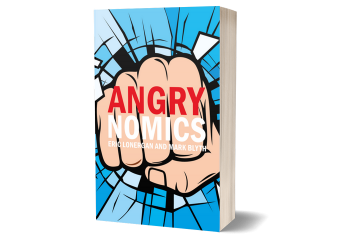
Eric Lonergan is a macro hedge fund manager, economist, and writer. His most recent book is Supercharge Me, co-authored with Corinne Sawers. He is also author of the international bestseller, Angrynomics, co-written with Mark Blyth, and published by Agenda. It was listed on the Financial Times must reads for Summer 2020. Prior to Angrynomics, he has written Money (2nd ed) published by Routledge. He has written for Foreign Affairs, The Financial Times, and The Economist. He also advises governments and policymakers. He first advocated expanding the tools of central banks to including cash transfers to households in the Financial Times in 2002. In December 2008, he advocated the policy as the most efficient way out of recession post-financial crisis, contributing to a growing debate over the need for ‘helicopter money’.
Reading much of the commentary on global government bond markets reveals that the Eurozone is still misunderstood. We have been here before. And, sadly, nothing has really changed. This post from 12 June 2022 i...
The bear market in bonds is a trend, with three fundamental causes
The most under-appreciated feature of the current bear market in bonds is also the most obvious one. Trend. That trend drives asset pric...
Perhaps the most important economics research paper in several decades was recently published in the Journal of Economic Perspectives, and it has largely gone unnoticed. It reveals that the Japanese governmen...
Economics keeps letting me down. The decade or so following the financial crisis spawned thousands of papers researching the financial system. I had a sinking feeling that none of it would help. Policy-making ...
Euro crisis II has started. The good news is that we have been here before, so we have learnt some lessons, the bad news is the that the underlying challenge is far greater: Italy - the likely epicentre of th...
When will the GameStop?
It is worth reflecting on the first major panic on the New York Stock Exchange in 1901. On that occasion two magnates, James Hill and Edward Harriman, one supported by Standard Oil, the ...
QE is not a liability transformation - it is debt reduction
The remuneration of bank reserves has been a source of significant analytical confusion among economists. This arcane technicality matters far more t...
I cannot think of a better interlocutor than Chris Dilow. He raises another set of interesting questions in his reply to my reply. I am in danger of completely forgetting our original divergence of thought, but...
Chris Dillow writes perhaps the most interesting economics blog I know. Its scope is considerable, and despite his declaration of bias - he self-identifies as a ‘marxist’ - he is typically empirical. His recent...
Post-lockdown the economy will need a different kind of stimulus
The role of monetary and fiscal policy during lockdown was to sustain household and corporate cashflows in the face of an intentional freezing o...